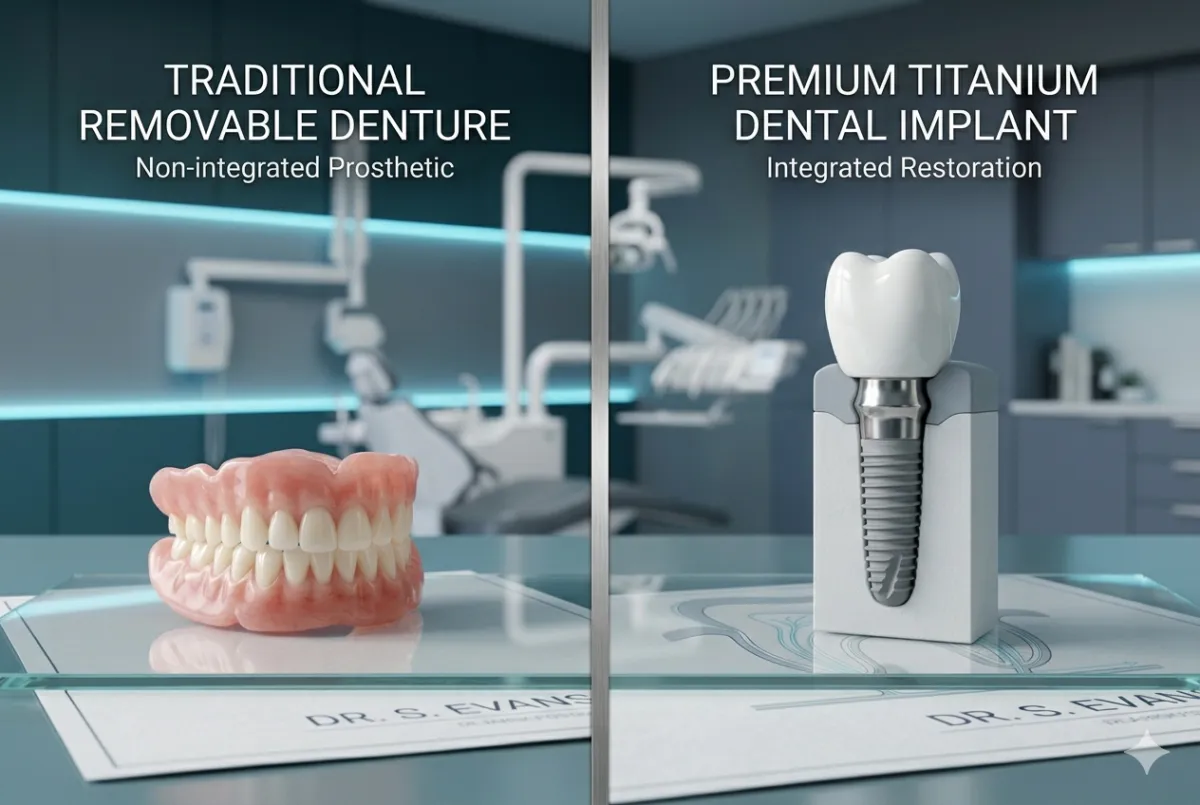
The Real Cost of Dentures vs. Implants | Lifetime Value
Dental Implant Affordability Guides
Dentures look affordable. That’s the point.
The upfront cost is lower, the treatment is faster, and the path of least resistance runs straight through the dental office’s most commonly recommended option for missing teeth. For patients focused on the number in front of them, dentures make sense.
The problem is that the upfront comparison is the least important part of the decision.
The full cost of choosing dentures over implants — financial, clinical, and nutritional — plays out over years and decades. Most patients only see the beginning of that picture when they’re sitting in the dental chair.
What Do Dentures Actually Cost Over Time?
A basic set of full dentures may run $1,000 to $3,000 per arch at initial placement. That number feels manageable compared to the cost of implant treatment.
But dentures are not a one-time purchase.
Most dentures require replacement every five to seven years as the mouth changes shape. Between replacements, relining — refitting the base of the denture to the changing contours of the gum ridge — is typically needed every two to three years. Adhesives become a recurring annual expense. Adjustment visits add up.
Over a 20-year window, the cumulative cost of dentures for both arches, including replacements, relines, adhesives, and maintenance visits, can reach $5,000 to $8,000 or more. That’s before factoring in the clinical consequences of what’s happening to the jawbone underneath.
What Happens to Your Jawbone When You Choose Dentures?
This is the part of the cost comparison that rarely appears on an estimate sheet.
Clinical research has found that in the first year following tooth extraction, patients can expect to lose approximately 25 percent of bone width and four millimeters of bone height in the affected area.[1] That process doesn’t stop after the first year. With dentures in place, bone resorption continues.
Dentures rest on the gum tissue. They do not transmit chewing forces into the jawbone the way natural tooth roots do. Without that stimulation, the body has no signal to maintain the bone, and resorption continues at its own pace.
As the bone shrinks, the denture fit changes. A set that fit well at delivery begins to feel loose within a few years. Retention decreases, sore spots develop, and the patient is back in the dental office for adjustments, relines, or a new set entirely.
That cycle drives the long-term cost of dentures well past the initial estimate.
How Does Bone Loss Affect Quality of Life and Nutrition?
The clinical consequences of bone loss extend beyond denture fit.
As the jawbone resorbs and denture stability decreases, chewing capacity declines with it. Denture wearers increasingly avoid the foods that require real biting force: coarse vegetables, fibrous meats, nuts, raw fruit, crusty bread.
These are not incidental omissions. Coarse, fibrous, nutrient-dense foods are the foundation of a diet that supports long-term health. The ability to eat them freely is one of the most significant functional differences between denture wearers and implant patients.
The dietary restrictions that come with long-term denture wear are rarely discussed at the point of treatment selection. They become apparent gradually, often without the patient connecting the dots back to the original decision.
How Do Implants Compare Over the Same Time Period?
Dental implants are designed to be a permanent solution.
Research reported by the American Dental Association found that dental implants demonstrated a 95.6 percent survival rate over a 38-to-40-year follow-up period.[2] The titanium post, once integrated with the jawbone, functions as an artificial root. It preserves bone by transmitting chewing forces directly into the jaw, the same way a natural tooth root does.
Over a 20-year window, an implant patient’s primary additional cost is typically a crown replacement after 15 to 20 years of use. There are no adhesives, no recurring relines, and no replacement sets.
The bone remains intact. Chewing capacity is preserved. The foods that denture wearers gradually give up remain on the menu.
When the full 20-year cost of dentures is set against the full 20-year cost of implants, the gap between the two closes significantly. In many cases, it reverses.
Is the Upfront Cost of Implants the Real Obstacle?
For most patients, the answer is no.
The upfront cost of implant treatment is real, and it’s higher than the upfront cost of dentures. But it is a number that can be structured, financed, and distributed over time in the same way any large necessary expense can be.
Patient financing programs, personal loans, Health Savings Accounts, Flexible Spending Accounts, and home equity lines of credit are all tools that reduce or spread the cost of treatment. Used in combination, they can bring the monthly commitment down to a number that fits within a real household budget.
The question worth asking isn’t whether dentures are cheaper today. It’s whether the total cost — financial, clinical, and nutritional — is lower over the life of the decision.
For most patients, it isn’t.
The Dental Implant Affordability Guides series includes dedicated guides to patient financing, Health Savings Accounts, and personal loans, covering how to structure the cost of implant treatment across multiple funding sources.
Frequently Asked Questions
References
[1] Zlataric DK, Celebic A, Valentic-Peruzovic M. “Complication Rates and Patient Satisfaction with Removable Dentures.” National Institutes of Health, National Library of Medicine. PMC3381202. pmc.ncbi.nlm.nih.gov/articles/PMC3381202
[2] American Dental Association. “40-Year Prognosis of Single-Tooth Dental Implants.” ADA News, reporting on research published in Clinical Implant Dentistry and Related Research. adanews.ada.org
